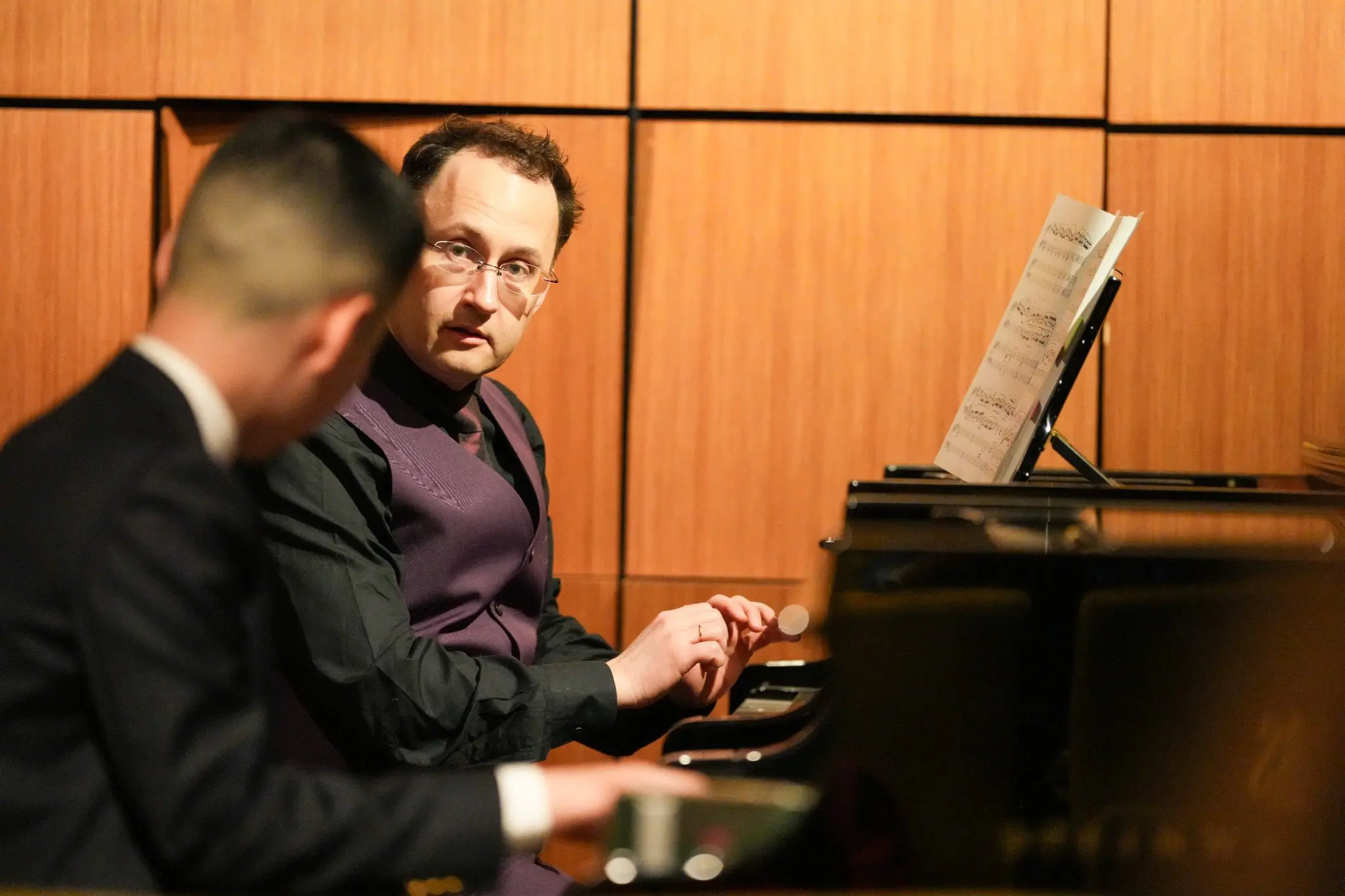
(Photo provided by Lang Lang Foundation. Alex Moutouzkine teaching students)
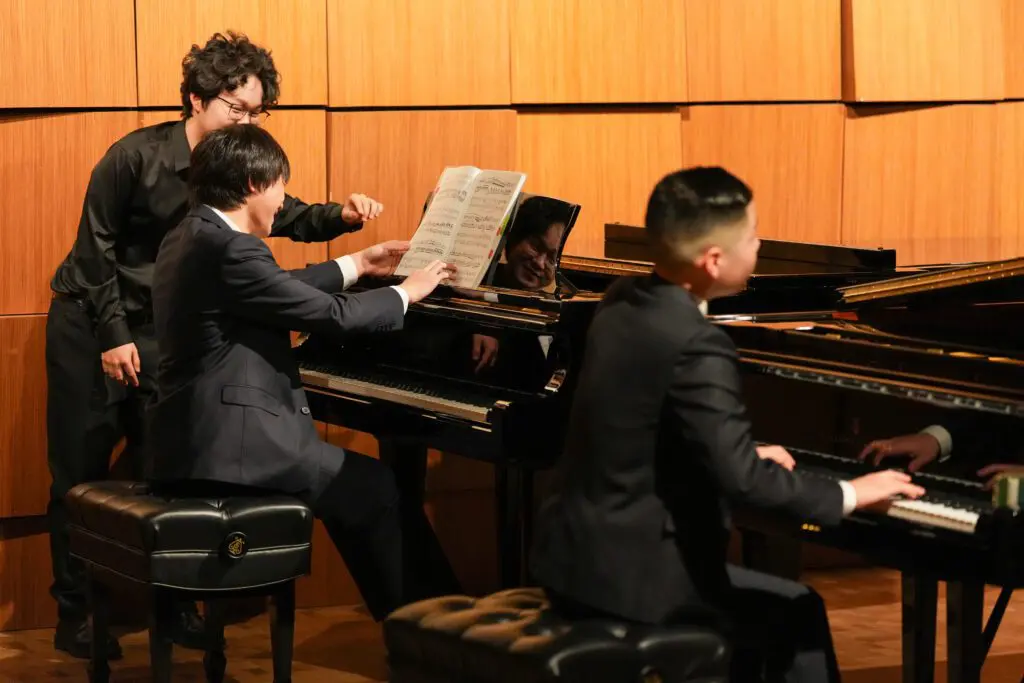
On a rainy spring afternoon near Bryant Park, students and parents gathered in the downstairs recital space at Steinway Hall for a Young Scholars master class presented by the Lang Lang International Music Foundation. One by one, young musicians stepped forward for individual instruction with concert pianist Alexandre Moutouzkine, working through sections of music as he paused to make adjustments as they played live.
The atmosphere inside the room was intensely focused. Certain passages were repeated as Professor Alexandre Moutouzkine demonstrated subtle changes in touch and pacing that completely reshaped the sound of a piece. Terms like “overtone,” “weight” and “double repetition” were mentioned throughout the lesson as the accomplished soloist and Co-Director of the Piano Department at the Manhattan School of Music explained how emotion and technical control work together in performance.
After the session, the students sat down with me for a conversation focused less on competition and about their relationship to the craft—and on music as a foundation for life.
Three Young Scholars — Taige, Alex, and Sencheng — spoke about the deeper philosophies shaping their connection to music, including discipline, curiosity, emotional awareness, and the psychological demands of refining an art form that never fully ends.
For 15-year-old Taige from New York City, the experience reflects years of dedication behind the scenes. “To be able to really study and master a piece… it takes so much time and dedication,” Taige explained.
“I’ve developed a sense of resilience and patience in everything I do.”
Alex, a 14-year-old scholar from New Jersey, spoke candidly about the pressure of balancing perfectionism with growth as a young musician, constantly trying to improve.
“One of the most difficult parts… is balancing the desire to polish a piece and develop a piece while also wanting to learn new music,” he said. “Piano music is endless.”
The Young Scholars Program, one of the foundation’s flagship initiatives, supports pianists between the ages of 13 and 18 through mentorship, performance opportunities, and training connected to institutions including Juilliard, the Royal Academy of Music, and the Manhattan School of Music.
But during the conversation inside Steinway Hall, the students focused less on prestige and more on mindset.
“I feel like staying curious is one of the most important things about playing music,” Alex said. “Music is not just reaching a goal and then staying there. It’s more of a lifelong journey. It never ends.”
He also emphasized that practice itself means little without focus and intention.
“It doesn’t matter how long you practice,” he added. “It’s what intent you have.”
‘Sen’ Sencheng, 15-year-old from Guangzhou, China, now living in New York, described music less as a performance and more as a form of emotional communication that evolves as young people grow older and gain life experience.
“Music is like expression,” he explained. “It’s like a language, and you can bring your life experiences into your music.”
The relationship between music and childhood development has increasingly become a focus within neuroscience research. According to research published through the National Institutes of Health, music training in children has been linked to stronger language development, attention span, memory retention, and executive functioning skills. Researchers at the USC Brain and Creativity Institute have also found that music education may accelerate auditory development and strengthen neural processing pathways in young children.
After the student interviews, program Mary Keating, speaking on behalf of the foundation, connected many of those findings directly to the organization’s broader mission surrounding music education access.
“If we all understood the neuroscience behind music, it would change our lives and our education system,” Keating said.
She explained that the foundation’s Keys of Inspiration initiative partners with public schools across the country to support students socially, emotionally, and academically through music education using a “whole child” approach.
“For some kids, they would never have known that they wanted to make music until we gave them that opportunity,” Keating added.
The students themselves also pushed back against long-standing ideas surrounding classical music, feeling inaccessible to younger generations.
“I want people to realize… this isn’t like this elitist thing,” Taige said. “Maybe you want to support the arts, maybe you just want to be a music lover… You should just find what you like in this world and try to build off of that gift.”
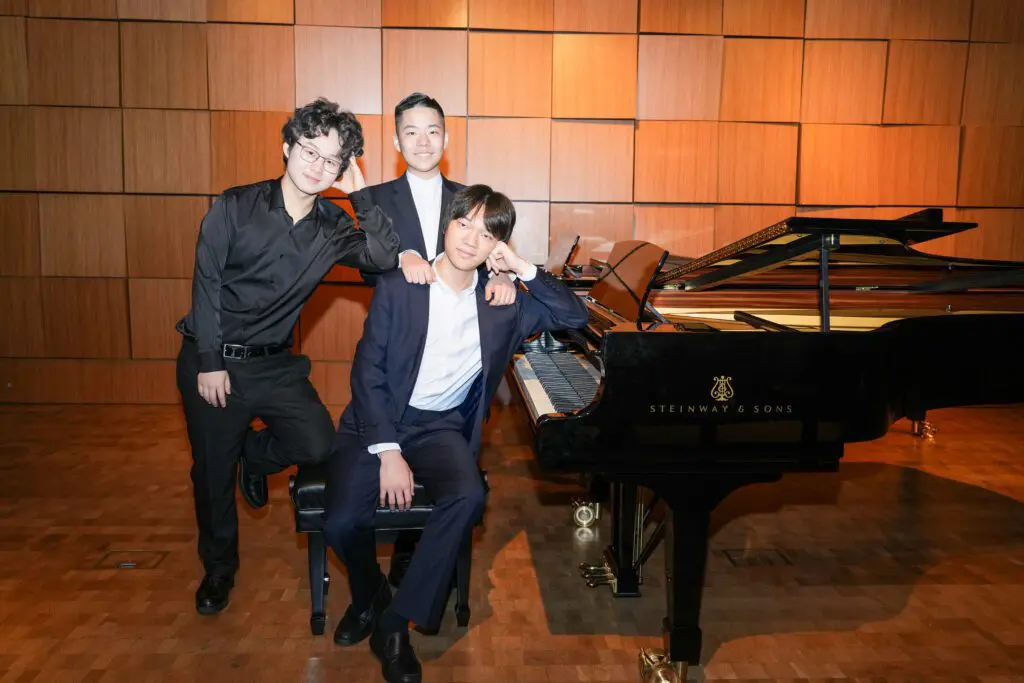
By the end of the afternoon, the master class revealed a larger theme. The students were learning concentration, emotional interpretation, communication, and patience through repetition and discipline — qualities many educators and neuroscientists increasingly argue are critical to childhood development itself.