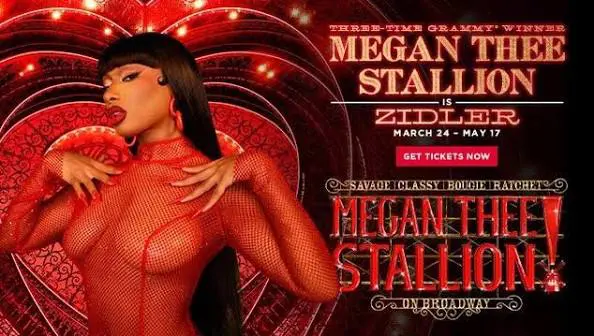
When Megan Thee Stallion steps onto a Broadway stage this spring, her debut marks a defining moment for one of American theater’s most influential cultural institutions.
The three-time Grammy Award winner will take on the role of Harold Zidler in Moulin Rouge! The Musical for a strictly limited eight-week engagement beginning March 24 at the Al Hirschfeld Theatre. The casting makes her the first female-identifying performer to portray the nightclub impresario in any production of the musical worldwide.
The announcement not a stunt for attention but confirmation of an industry shift already underway. Contemporary rappers and R&B artists are no longer visiting Broadway for prestige. They are expanding who gains entry to one of America’s most valuable creative economies.
Broadway generates billions annually for New York City. According to the Broadway League, the 2022–2023 season contributed roughly $14.7 billion in total economic impact to the city following pandemic shutdowns. Audience recovery depended heavily on younger and more diverse ticket buyers returning to theaters once productions reopened.
Demographics changed alongside economics. Pre-pandemic Broadway audiences were overwhelmingly white. By the 2022–2023 season, audiences identifying as Black, Latino, Asian, or multiracial grew to nearly 40 percent of ticket buyers, one of the highest recorded levels in League tracking reports. Casting trends followed audience demand. Productions increasingly sought artists with built-in cultural reach capable of drawing communities historically priced out or culturally disconnected from theatergoing.
Megan Thee Stallion’s arrival continues a trajectory shaped over the past decade by performers moving between recording studios, streaming platforms, film, and live theater. Hip-hop artists now enter Broadway with established storytelling instincts, performance stamina, and global fan ecosystems that translate directly into ticket sales.

Broadway producers, once cautious about genre crossover, learned a costly lesson during COVID closures: survival depends on expanding cultural access rather than protecting institutional gatekeeping.
Recent seasons have demonstrated measurable financial correlation between diverse casting and commercial longevity. Productions featuring artists of color have driven strong tourism recovery and group sales, particularly among first-time theater audiences. Industry labor data also shows that performers, musicians, stagehands, designers, and front-of-house workers from nonwhite backgrounds represent a growing share of Broadway’s employment base, reinforcing how diversity functions as economic infrastructure rather than symbolic inclusion.
In that context, Megan’s casting reframes conversation often reduced to diversity initiatives. Broadway’s evolution now reflects market logic. Talent that commands attention across music, digital media, and live performance expands audience pipelines faster than traditional theater promotion ever could.
Producer Carmen Pavlovic described the casting as part of the musical’s closing celebration ahead of its announced July 2026 finale. Megan herself acknowledged Broadway’s demands, noting theater requires a different level of discipline and preparation than touring or recording.
That distinction matters. Broadway remains one of the few performance environments where celebrity alone cannot sustain a run. Eight shows a week test endurance, vocal control, timing, and ensemble collaboration. Success depends on craft.
Hip-hop’s migration to theater also mirrors broader cultural exchange already visible across film scoring, fashion houses, and museum programming. Artists trained in improvisation, lyrical narrative, and live audience responsiveness arrive prepared for theatrical storytelling even without conservatory backgrounds.
Post-pandemic Broadway increasingly rewards fluidity..
The result is an industry less concerned with preserving hierarchy than maintaining relevance. Streaming reshaped entertainment consumption. Social platforms reshaped fame. Broadway now competes inside that ecosystem rather than outside it.
Megan Thee Stallion stepping onto a Broadway stage reflects an industry recalibrating access through audience reality.
And Broadway, once defined by extreme gate keeping , grows strongest when cultural ownership widens beyond stagnate demographics.
Megan Thee Stallion’s limited Broadway engagement runs March 24 through May 17, 2026 at the Al Hirschfeld Theatre, with tickets available at the official production site, https://moulinrougemusical.com/ , or in person at the theater box office (302 West 45th Street, New York, NY).