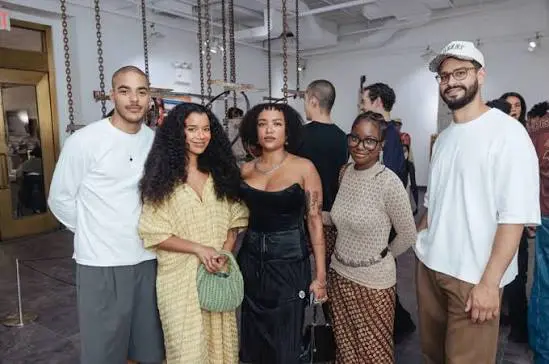
Curator Dr. Margarita Rosa with participating artists
Under a Plantain Tree begins with a decision made by Dr. Margarita Rosa’s grandfather, while sitting beneath its leaves: he would leave the Dominican Republic and migrate to the United States.
For Rosa, his decision reveals what can happen when a person finally has enough space to think. Plantain fields across the Caribbean were places of forced labor for Black and Indigenous people. Their shade also gave workers moments of respite.
This memory became the inspiration for Under a Plantain Tree: Notes on Liberation.
“Under a Plantain Tree came about because I thought of the long history that plantain fields have formed in the Caribbean as a site of labor, respite and thought,” Rosa said.
The exhibition is on view at the Jamaica Center for Arts and Learning from June 19 through Aug. 14, 2026. It opened on Juneteenth and held a public program on July 10. Rosa brings together Yanira Collado, Zion Estrada, Laurena Finéus, Luis Gutierrez, Jeffrey Meris, Naudline Pierre, Bony Ramirez, Ronald “EFE” Ramirez and Raelis Vasquez.
The work moves through Haiti, the Dominican Republic, Colombia and the United States. African American freedom struggles remain central to the diasporic story Rosa tells.
Rosa was born in the Dominican countryside and raised in a small Afro-Indigenous farming community. Nearly 90% of what her family ate came from the land. When her mother could not breastfeed and formula was inaccessible, she picked oranges from a tree outside their home and fed them to Rosa.
“That is one of the ways that the land continuously fed us,” she said. “The Afro-Indigenous small farm economy that I was raised in really informs how I think about subsistence, land and historical rebellion.”
Rosa later trained at Princeton University as a historian of African American, Caribbean and Brazilian history. Her study of Dominican history led her to maroon societies created by people who escaped slavery and built communities in mountains, mangroves and swamps.
“Everything in my culture, including today, pointed to these maroon societies that led me to study Black rebellion across the Americas,” Rosa said.
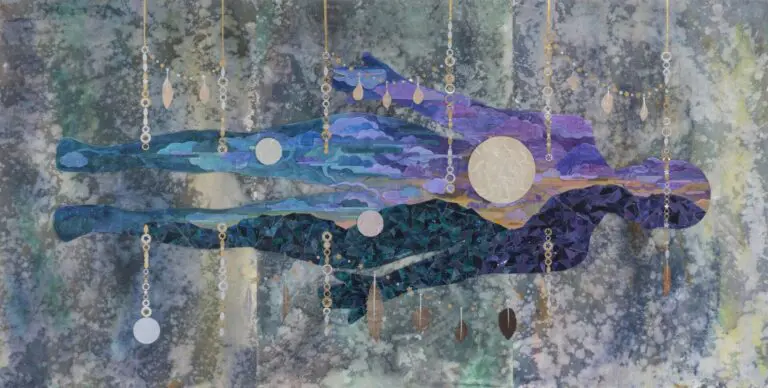
Across the exhibition, artists turn daily objects and familiar places into what Rosa calls “technologies of resistance.”
Ronald “EFE” Ramirez created 3 rings fitted with pointed machetes. The formation recalls the final battle of the Haitian Revolution and the farming tools used by rebels.
“The exhibition really came about because I was thinking about the combination of everyday objects and rebellions,” Rosa said.
Jeffrey Meris created 2 fire doors. Born in Haiti and raised in Barbados, Meris drew from his experience as a gay Black man whose body is often read as dangerous or defiant. Rosa said the doors came from his need to find “several escapes and protections against the multiple readings that his body is put through every single day.”
Laurena Finéus paints mangroves and swamps as sites of self-emancipation.
Zion Estrada’s 12-minute film 2,340 Miles from 1880 follows the Mississippi River through found footage, archival papers, digital drawings and field recordings. The film connects plantation worker strikes before the Great Migration to Black movement and work stoppage.
Estrada’s Unfolded Histories: Bellefonte, Mapping Blackness layers maps, fossils and the movement of free Black people through Pennsylvania. Jessie Crawley, a matriarch from a 5-generation Black family, appears at rest.
“Mangroves and swamps were essential to the Maroon tribes,” Rosa said.
In one filmed exchange, someone asks, “How can I support you?” The answer is direct: “You can liberate my people.”
“The ways that Zion is thinking about liberation are deeply personal, deeply everyday,” Rosa said.
Luis Gutierrez examines post-emancipation labor struggles on plantain plantations in Colombia. Rosa connects those struggles to Juneteenth, the Haitian Revolution and W.E.B. Du Bois’ argument that enslaved people helped decide the Civil War through mass work stoppages.
“Juneteenth is intrinsically connected to the Haitian Revolution,” she said.
“There is no one legal right that I have in the United States, as an Afro-Indigenous migrant, that wasn’t given to me by an African American freedom fighter,” Rosa said.
Rosa wants visitors to leave believing their choices matter.
“Liberation happens in the everyday interaction, the everyday grace, the everyday mutual faith that we are able to give to others around us,” she said. “There is no structural liberation without individual action. We all have to make this happen.”
Related coverage on New York Edge News
How Dandyism Defines Liberation, Identity, and Creativity Across Generations
Heidelbergology at 40: Tyree Guyton’s Living Art Economy in Detroit
Prison Reform Takes Center Stage: Russell Craig’s New Art Debuts at The Prisoner Ball