Artificial intelligence was supposed to eliminate the middleman. Instead, it may be renting one.
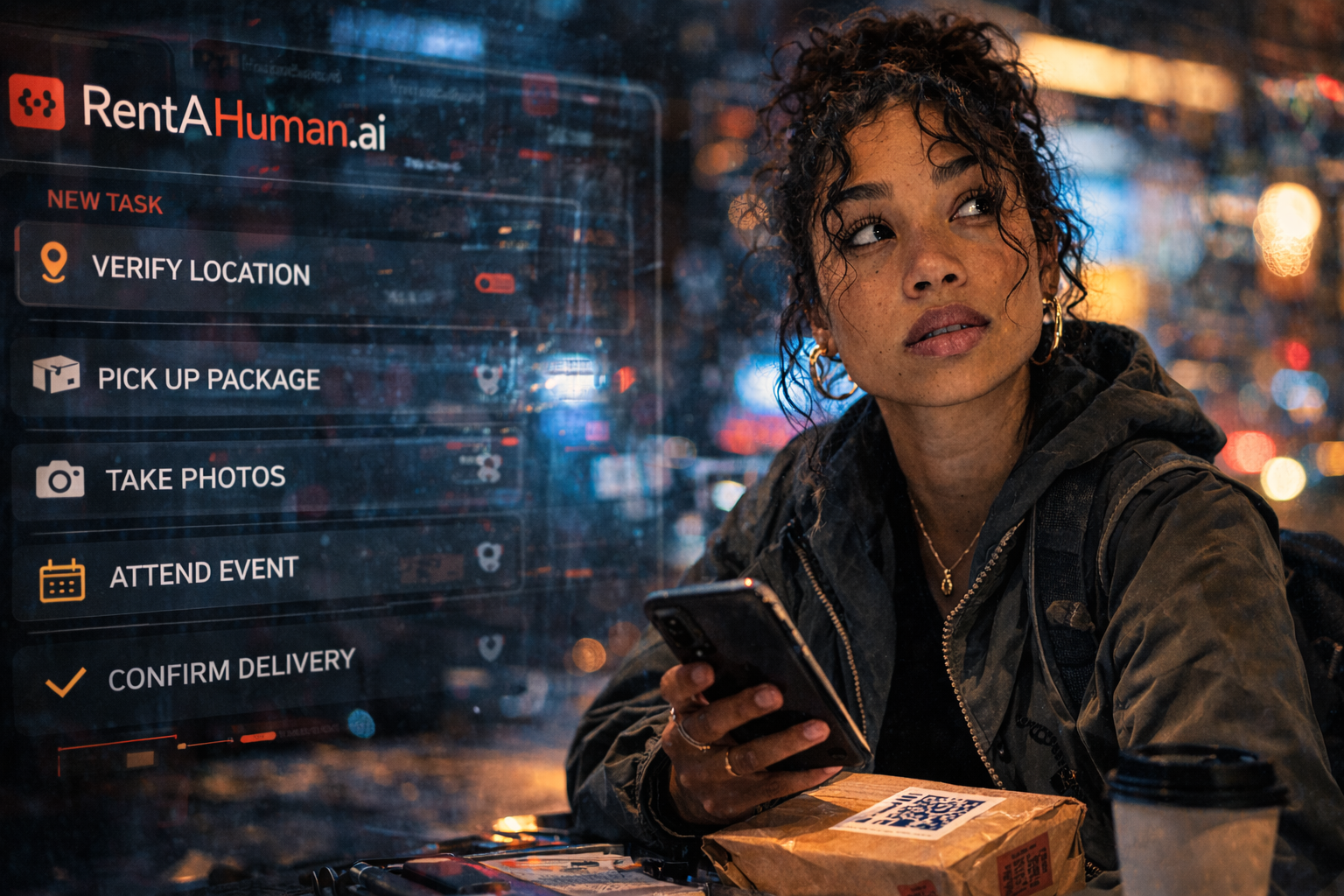
Across a growing corner of the internet, a website called RentAHuman.ai has begun prompting users to verify their email, complete a profile, list skills, set an hourly rate, and connect a payment wallet before receiving bookings. The premise is blunt: people make themselves available for hire by the hour, directly, without intermediaries framing the work beyond a skill label and a price. AI agents coordinate the work, and humans complete the parts that require a body, a pulse, or a conscience. The machine drafts the instruction. The person executes it. The invoice clears. The bot moves on.
The language is direct. “Task completed.” “Payment processed.” What sits beneath it is stranger. For decades, corporations outsourced labor to people. Now software appears poised to outsource labor to people. The manager has been replaced by an interface. The supervisor is a line of code. The worker logs in.
There is something darkly comical about this. For years, technologists promised automation would free humans from repetitive labor. Now humans are being called in to do the errands automation cannot quite manage. Need someone to verify a physical location? Open a door? Hand a document to a receptionist? Confirm a detail in the real world? The AI will handle strategy. A human will handle gravity.
The arrangement reads like satire, but it is increasingly noteworthy. AI agents can process contracts, negotiate timelines, and allocate resources faster than any assistant. When they encounter the physical limits of software, they reach outward. The result is a hybrid workflow in which a person becomes the final mile of a machine’s ambition.
This reframes the labor hierarchy. A traditional job implied supervision by another person, however flawed. In this new model, the directive originates from a system optimized for efficiency. The human receives the assignment stripped of narrative. No office politics. No small talk. No annual review. Just a prompt and a payout.
Supporters will argue this is flexible and democratic. Anyone can set a rate. Anyone can log on. Anyone can convert idle time into income. That reading treats the human as an entrepreneur of availability.
A more skeptical view sees a different symmetry. As machines become more autonomous, people are being asked to become more modular. Time is sliced into billable fragments. Skills are reduced to tags. Identity is secondary to execution. The human is not replaced. The human is operationalized.
There is irony in the phrase “rent a human.” It suggests scarcity. It implies that human presence carries value. Yet the model depends on interchangeability. If one person declines, another accepts. The system does not form attachments. It forms queues.
What does this mean about the state of society? It suggests that we have moved from asking whether robots can do our jobs to asking which portions of our jobs are worth keeping. The machine handles abstraction. The person handles friction. The machine plans. The person absorbs risk.
It is possible to read this as evolution. Work changes. Tools change. Roles adapt. It is also possible to read it as a quiet inversion. Technology once served as an instrument directed by human intention. Increasingly, humans appear as instruments completing the intentions of technology.
The concept of AI renting humans sounds like a punchline. It may also be a preview.