
Sun Ra’s Spirit Lives on in Xenobia Bailey’s ICA Philadelphia Installation
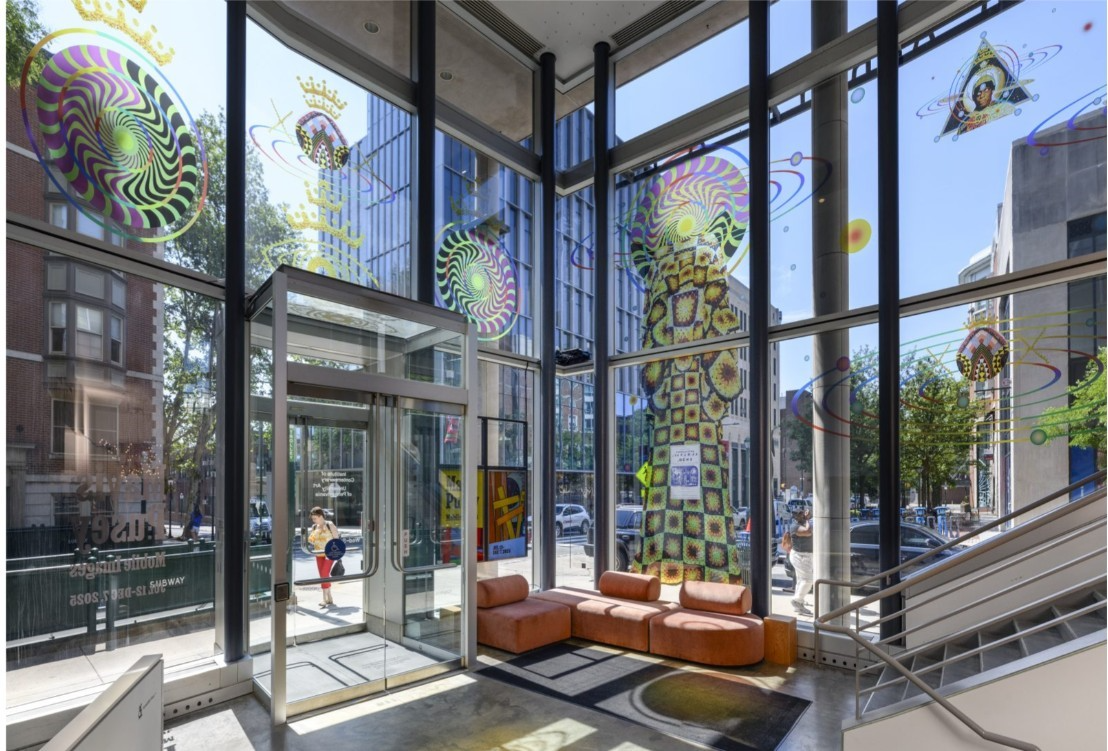
Xenobia Bailey Turns ICA Philadelphia Into a Portal of Afrofuturist Design
Since July 2025, the Institute of Contemporary Art in Philadelphia has stood wrapped in color, movement and history through Entryways: Xenobia Bailey. The 400-square-foot public installation, commissioned by ICA and created in partnership with Maharam, transforms the building’s façade into a living statement on Black cultural innovation.
Bailey’s “Funktional” design pulls from domestic crochet traditions, Yoruba masquerade and the vision of Philadelphia’s own Sun Ra. The central image — digitally composed from Bailey’s crocheted textiles — places Sun Ra at the forefront, surrounded by orbiting astrological symbols and layered color fields. The composition doesn’t just decorate the building, it recasts the entrance as an encounter with a living cultural archive.
The project began with Bailey hand-crocheting pieces of vibrant yarn, draping them over a ladder and photographing them. Those photographs became the building blocks of the final design, merging craft and digital technique. The result channels the spirit of Sun Ra Arkestra, which blended music, philosophy and spectacle into a complete way of life.

Xenobia Bailey’s Hand-Crocheted Pieces
Later this year, the work expands into augmented reality. Visitors will be able to view Bailey’s masquerade-inspired forms suspended in virtual space, extending the installation beyond the building’s surface. It marks the first time Bailey’s crochet-based practice enters a digital, interactive format — a move that builds on her lifelong interest in how Black aesthetics adapt across time and technology.
“Her crochet practice—deeply tied to Black utilitarian makers and domestic craft—now meets architecture and technology in a way that speaks to both ancestral heritage and future possibility,” says ICA’s Andrea B. Laporte Curator Denise Ryner.
Entryways continues Bailey’s long-running series Paradise Under Reconstruction in the Aesthetic of Funk, an ongoing exploration of African American visual culture. Since the 1980s, she has elevated crochet from functional object to sculptural form, using it to preserve memory, create sanctuary and affirm cultural identity. Born in Seattle and raised in both rural and urban Washington, Bailey grew up attuned to seasonal rhythms, land-based living and the resourcefulness of homemakers like her mother who infused interiors with vibrant textiles.
At ICA, those influences converge with a direct nod to Sun Ra, whose music and philosophy challenged audiences to imagine new worlds. Bailey’s work captures that same sense of possibility — not as nostalgia, but as an active, forward-looking practice.
Entryways: Xenobia Bailey is free and open to the public at ICA Philadelphia through August 9, 2026.
Author

Downtown Urban Arts Festival, June 2025 Leah Mijalski-Fahim’s Face Value flirts with provocative themes and throws them headfirst into the
From Blue Fairy to AI Friend: Can Microsoft’s Copilot Truly Deliver Human Connection and Inclusivity

In Artificial Intelligence, the fictional character David searches endlessly for his Blue Fairy, a mythical figure he believes can turn

By Amanda Smith for New York Edge News This moment in digital history is one for the books. Never before

In the era of private rockets and celebrity space tourists, few names shout edge and attitude like Oakley. The California-based
Xenobia Bailey Turns ICA Philadelphia Into a Portal of Afrofuturist DesignSince July 2025, the Institute of Contemporary Art in Philadelphia

Jordan Peele’s HIM Pushes Fame to Its Darkest Limits What would you sacrifice to become the greatest of all time?

From Cleopatra’s Kohl to CocoLash: The Ultimate Fake Eyelash Story and Review By Annette Whitehead for New York Edge NewsFake

By New York Edge News Staff As lawmakers wrapped up Crypto Week in Washington, where competing visions for digital currency took

By Amanda Smith for New York Edge News Notetaking and transcribing needs have existed as long as humans. The mechanism

By New York Edge News Ashanti Abdullah’s path into software design didn’t follow the typical Stanford or Harvard cookie-cutter mold-his
Share
CATEGORIES
Need More Help