By Amanda Smith for New York Edge News
Notetaking and transcribing needs have existed as long as humans. The mechanism of recording conversations has evolved over time, but the essence of the action has remained unchanged: Record and recall.
The ancient Egyptians used clay to record laws, trade, and traditions. The Greeks used wax to document speeches and theories. The monks and scholars used their hands as their writing instruments.
We’ve had the pen and paper, the typewriter, the computer, the iPhone, and the myriad of apps that have spurred these innovations – Evernote, Apple Notes and voice notes, for example.
And now, as ChatGPT ushers AI into mainstream conversations and consciousness, it’s wearable AI notetakers.

While the tools that came before took notes, they didn’t “free your intelligence” like PLAUD AI, a wearable AI memory capsule, promises to do. In a recent demo and discussion held at their New York City office at 4 World Trade Center , PLAUD announced they hit one million users.
Its use case is simple: Capture, extract and utilize real-world intelligence – because there’s intelligence behind every human interaction. Up until now, the onus has been on the individual to record and recall the right details, which is subjective and simply unproductive.
From the times of “meeting minutes” to the impersonality and intrusiveness of AI agents today, there has been a gap for a wearable device that records meetings on the move, with studio grade quality and AI enhancements.
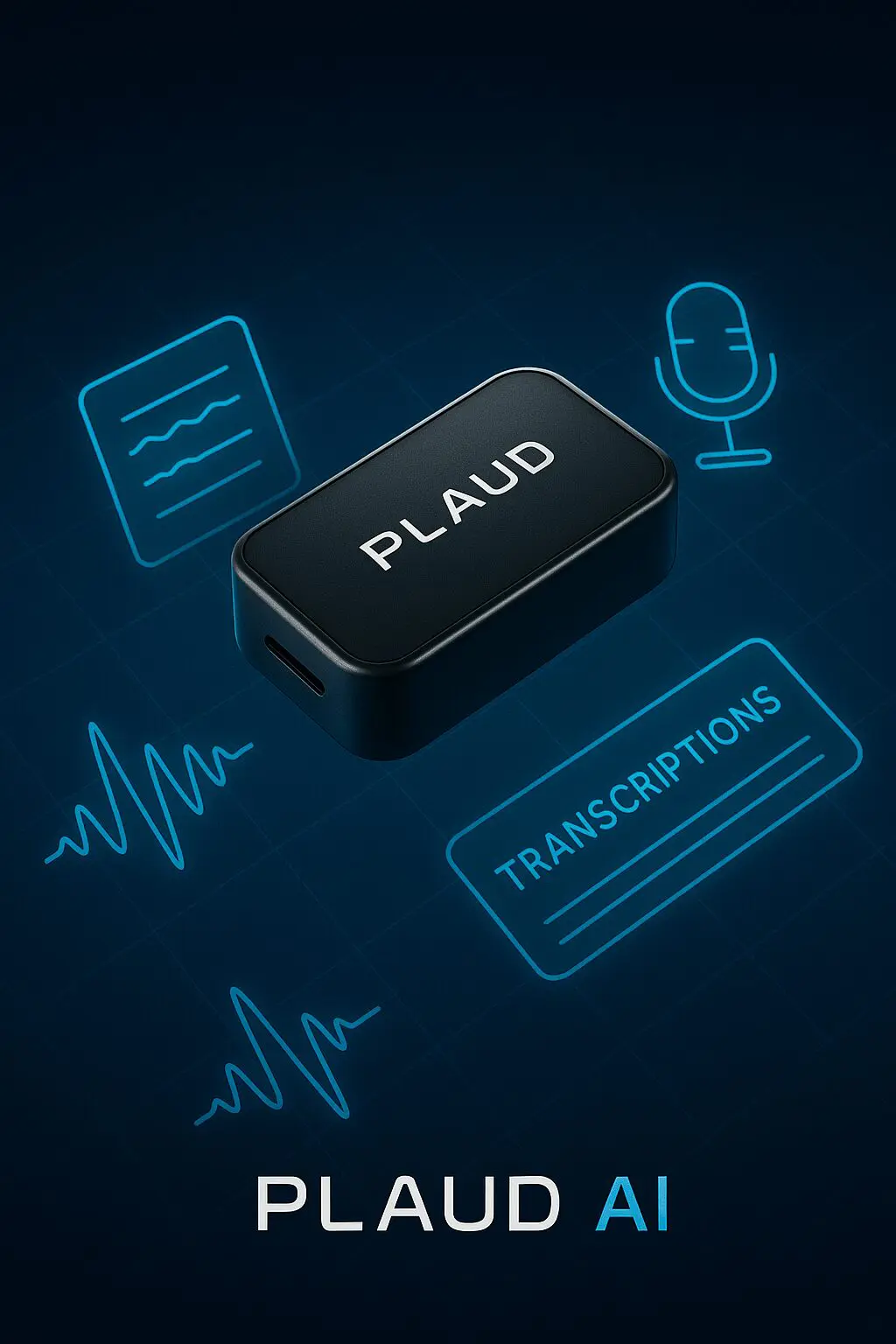
PLAUD presents as a wearable clip, wristband or lanyard, or as a sleek device the size of a credit card that attaches to a smartphone.
“We don’t tell you what to say next or how to close a deal during a meeting. What we offer is the reflection after the conversation by giving you suggestions. It might advise changing the way you ask questions or bringing up an unsolved issue in a next meeting,” said Elina Tsao, PLAUD’s Head of Brand.
While tools like Otter save time on transcription, PLAUD is changing the way people take notes – recording meetings on the move with noise cancellation, AI suggestions, and profession-specific templates.
“We want you to integrate the conversations you have into your workflow and to get more engaged in your meetings,” Tsao said.
She highlighted how the combination of hardware, software, cloud and AI is what makes PLAUD special. The deliberate physical action of turning it on and visibly seeing it adds a psychological element of safety, not fear.
PLAUD only uses servers based in the United States and is HIPAA compliant, with more than 20% of users being medical professionals. Other professions include lawyers, doctors, dentists, sales managers, project managers, CEOs, lecturers, and students.
- Tsao stresses they don’t want to replace people but rather give more agency to users with AI technology. Half of the attendees in the room were using pen and paper, while the other half typed on their laptops or took no notes at all. Even with all the innovation, there’s still something powerful about the process of putting pen to paper. Research has shown writing by hand strengthens content processing and connection.
So, are we getting in over our head with all this tech?
Could a disgruntled employee report someone to HR, with their PLAUD transcript? Maybe. Could an individual use it personally to “outsource memory”? It’s possible. These are concerns with no clear answer, as we move into a world of wearable AI accessories.
Having a hands-free device with end-to-end encryption is handy for any profession who relies on taking notes, but AI productivity tools need to ensure a balanced focus on efficiency and ethics. A tool marketed as a wearable AI memory capsule will undoubtedly go beyond the boardroom.
And when everything is being recorded and critiqued, how will it change the tone, delivery and substance of conversation? Can it really be a one-on-one meeting if AI has access to it? Smarter notes or the start of a whole new conversation? Or, maybe both.
Visit PLAUD AI’s official site to explore device and features.
URL: https://www.plaud.ai