Revival of a classic: Ceremonies in Dark Old Men
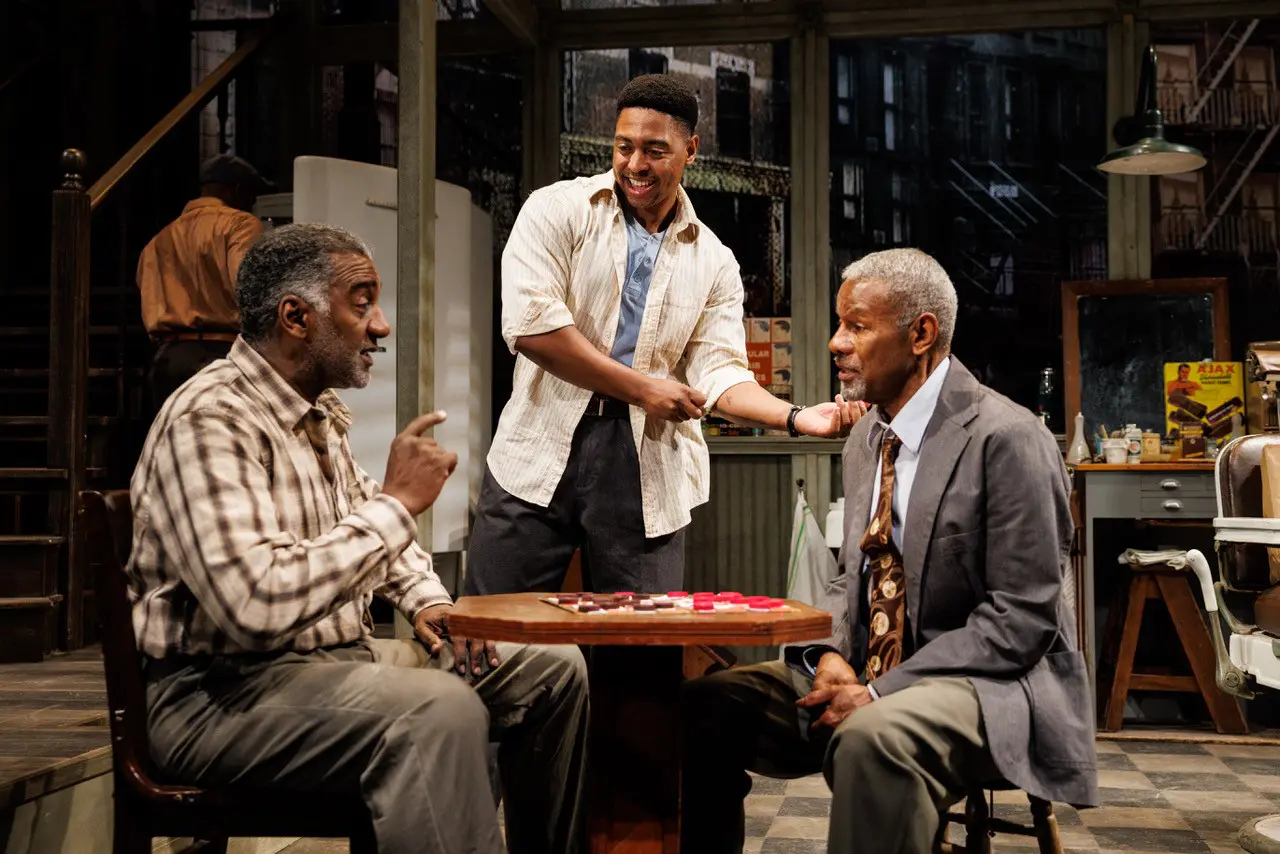
In the barbershop with lighthearted banter and be, pals Parker and Jenkins play checkers before the drama of this story begins.
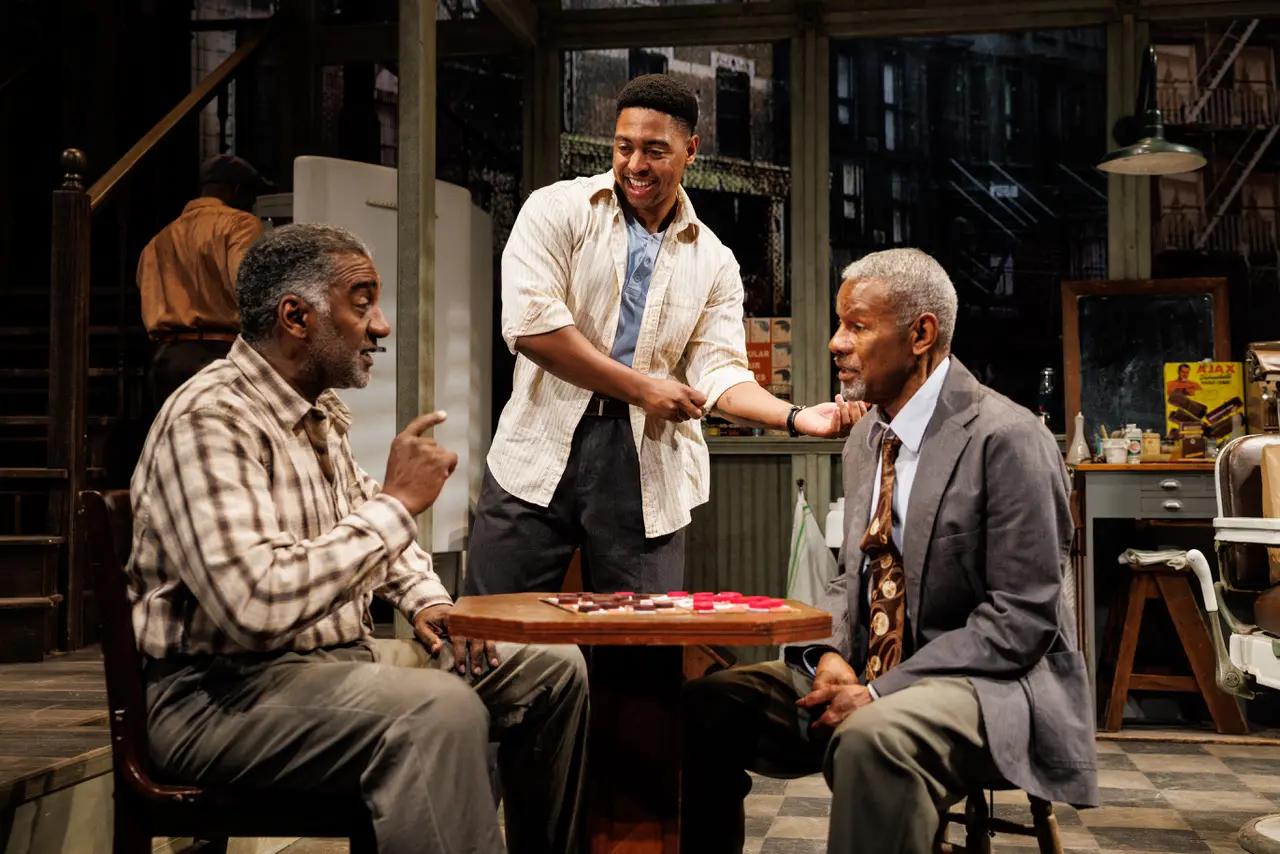
Norm Lewis, Bryce Wood, and James Foster Jr. in CEREMONIES IN DARK OLD MEN. Photo Credit: Maria Baranova
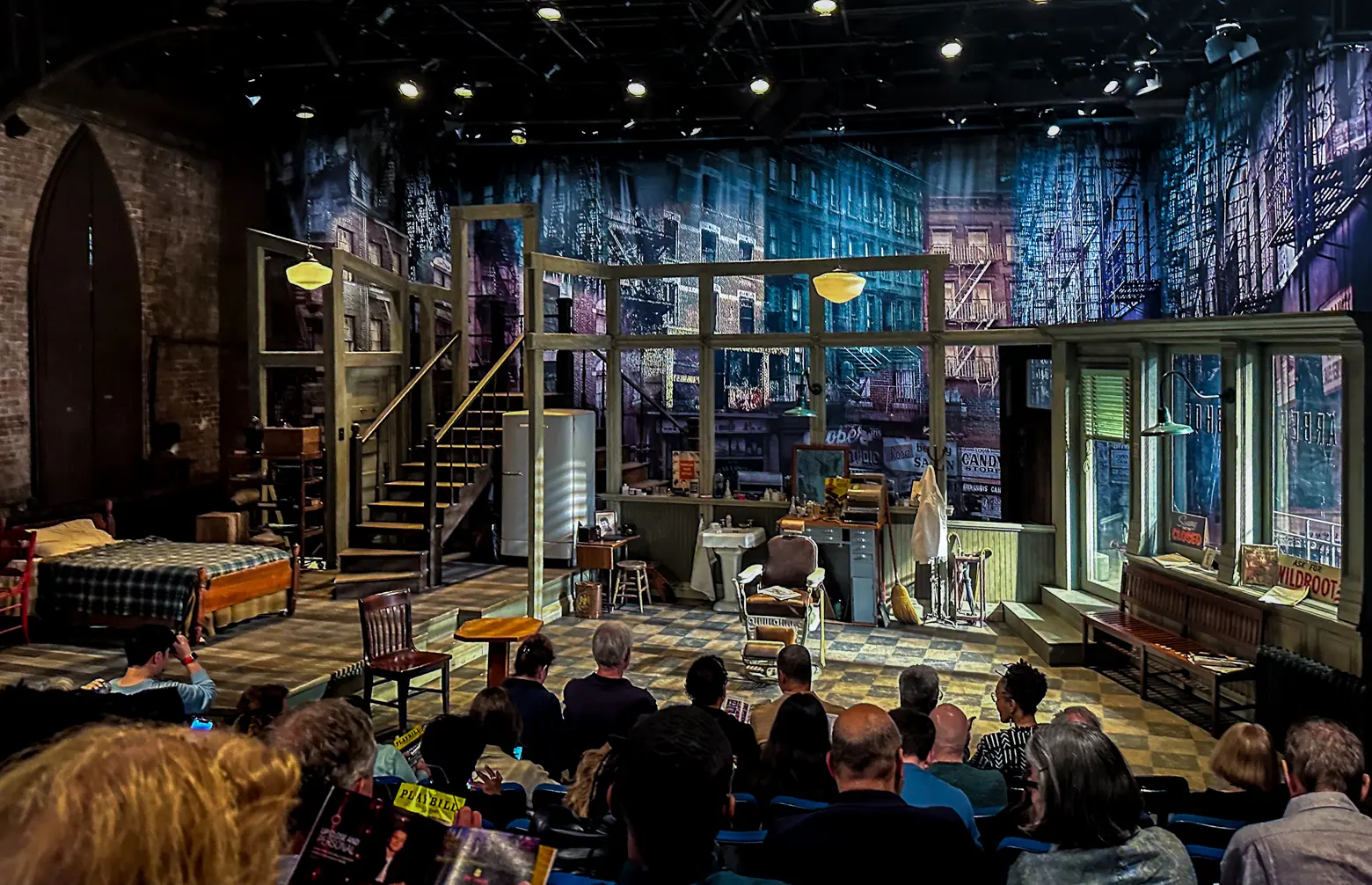
With excited anticipation, audience members enter Theatre at St. Clements on W. 46 St., an Off-Broadway space created within the church’s sanctuary, and immediately before their eyes for all to see, they happen upon the multi-dimensional suggestive set of Ceremonies in Dark Old Men. This is the play these theatergoers are about to experience and what an environment the audience finds itself in!
Scenic designer Harry Feiner creates an inspired 1950s theatrical set with images of fire-escape clad, red and brown brick urban tenements that wrap the back of the stage, evoking the neighborhood of this story. Center stage, where most of the action takes place, is the Harlem barbershop recreation of those times.
The barbershop in the Black community is iconic; not merely a place for men to get groomed, but long recognized as a gathering place, a place for Black men to read newspapers, exchange local news and gossip. While historically it has offered opportunities for Black entrepreneurship, it serves as the local community center for men, a place where one can be heard, a haven from the outside world.
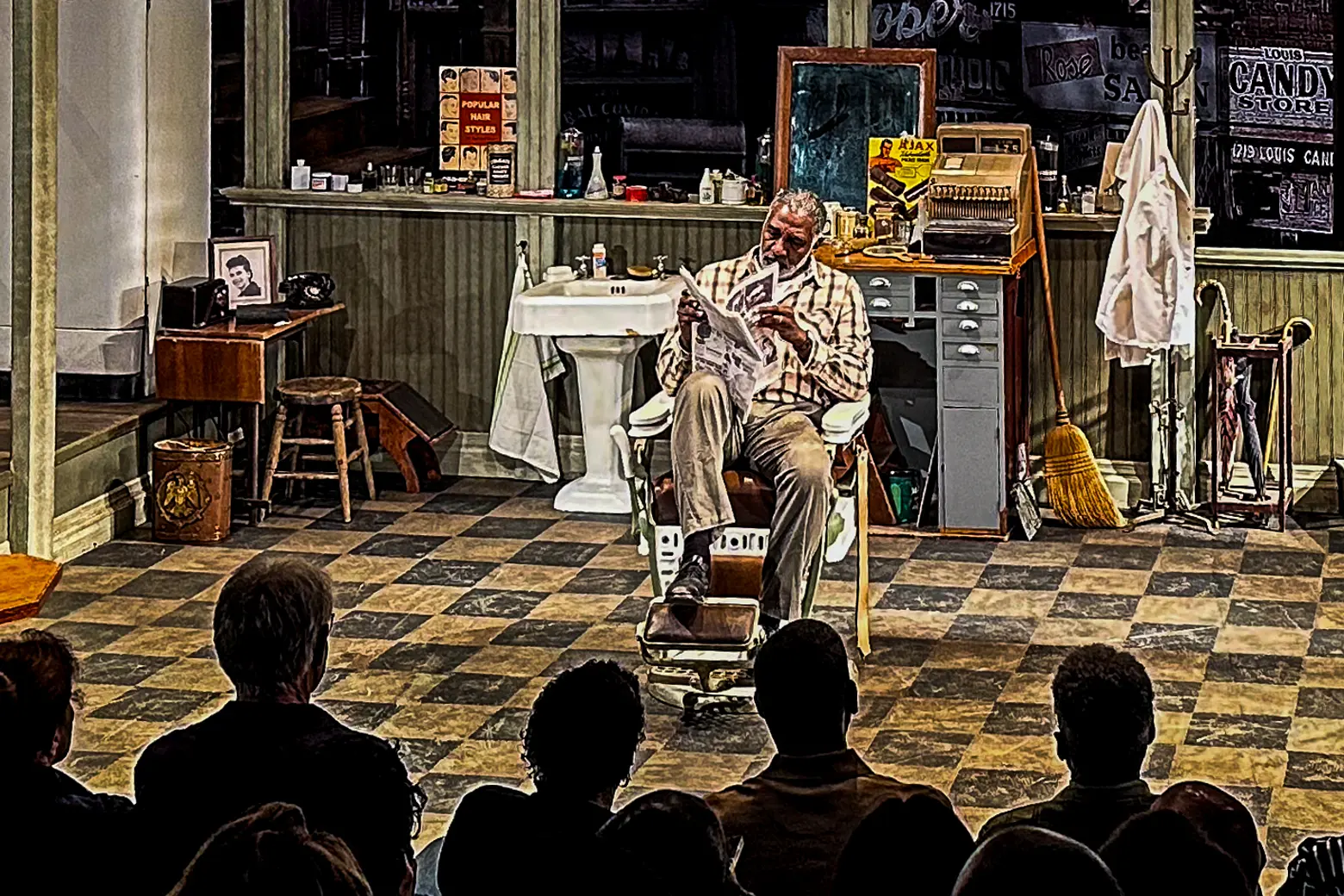
As the play begins, barber Russell Parker, the father in this family drama puts away his newspaper to join his good friend Jenkins in their regular game of checkers.
Not long after, the sanctuary status of this barbershop shifts to focus on the increasingly tension fraught family interactions amidst the father and the three adult children, a daughter and two sons. This story continues in its two acts and four scenes.
We learn that widowed Russell Parker is a former vaudeville hoofer who when no longer able to dance opened the barbershop. We learn, from the bitter remembrances of his daughter Adele, that her mother, his wife worked all the time to support the family until she fell ill and died.
Now, Adele carries the family economic load just like her mother did while her brothers, a college drop-out and the other a petty thief, do not have jobs and bristle at the thought of “working for the man.” In actuality, their father is not really working either and Adele is fed-up. She communicates to the ne’er-do-well men in her family: Get a job or that’s it!
This sets in motion the shady business—setting up a bootlegging operation—that Theo, the older brother and his father enlist in, partnering with slick, smooth talking Blue Haven, the neighborhood heavy. All leads to dramatic consequences.
In the 1960s, playwright Lonnie Elder III began to explore the themes of the Black family unit in a hostile American environment. Previously, as an actor, he launched the the role of Bobo in the original 1959 Broadway production of Lorraine Hansberry’s classic A Raisin in the Sun, that shares many common sensibilities with Ceremonies.
Ceremonies in Dark Old Men was first performed at St. Mark’s Playhouse in 1969, produced by the Negro Ensemble Company. It had three theatrical runs in New York City, was the runner-up for the 1969 Pulitzer Prize in Drama, has been widely produced regionally, and in 1975 was adapted into a television movie.
With Tony and Emmy nominee Norm Lewis starring as Russell Parker, this is Ceremonies first New York City revival in 40 years.
Theatre lovers, followers of this play in particular, and fans of Norm Lewis were among those who packed last week’s opening night at Theatre at St. Clements. The play will also appeal to those who are fans of Black authors and the history of Harlem of that era.
Co-presenter, The Peccadillo Theater Company is dedicated to the rediscovery of classic American theater. In the informative Playbill program, it is noted that “Taken as a whole, this work represents nothing less than the American experience itself in all its contractions and screwball energy.” The Peccadillo sees its mission to restore buried gems to their rightful owner—the American theatergoer. The theatre world benefits from this mission.
Author

Downtown Urban Arts Festival, June 2025 Leah Mijalski-Fahim’s Face Value flirts with provocative themes and throws them headfirst into the
From Blue Fairy to AI Friend: Can Microsoft’s Copilot Truly Deliver Human Connection and Inclusivity

In Artificial Intelligence, the fictional character David searches endlessly for his Blue Fairy, a mythical figure he believes can turn

By Amanda Smith for New York Edge News This moment in digital history is one for the books. Never before

In the era of private rockets and celebrity space tourists, few names shout edge and attitude like Oakley. The California-based
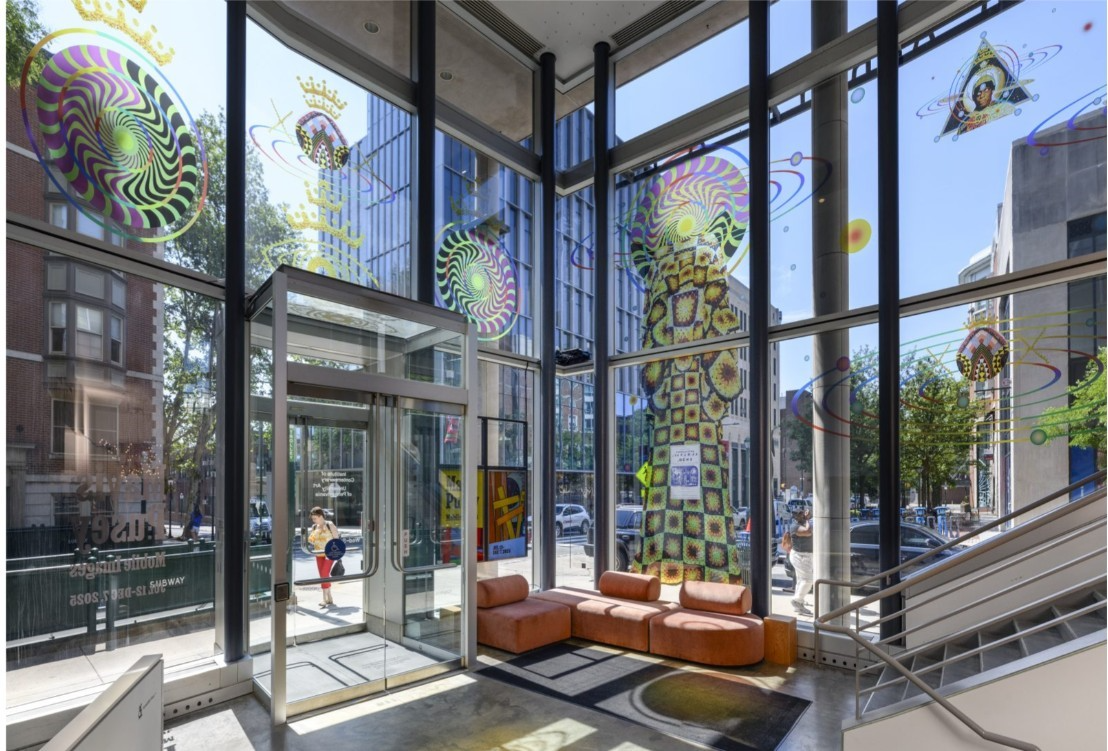
Xenobia Bailey Turns ICA Philadelphia Into a Portal of Afrofuturist DesignSince July 2025, the Institute of Contemporary Art in Philadelphia
Jordan Peele’s HIM Pushes Fame to Its Darkest Limits What would you sacrifice to become the greatest of all time?

From Cleopatra’s Kohl to CocoLash: The Ultimate Fake Eyelash Story and Review By Annette Whitehead for New York Edge NewsFake

By New York Edge News Staff As lawmakers wrapped up Crypto Week in Washington, where competing visions for digital currency took

By Amanda Smith for New York Edge News Notetaking and transcribing needs have existed as long as humans. The mechanism
By New York Edge News Ashanti Abdullah’s path into software design didn’t follow the typical Stanford or Harvard cookie-cutter mold-his
Share
CATEGORIES
Need More Help