Heidelbergology at 40: Tyree Guyton’s Living Art Economy in Detroit
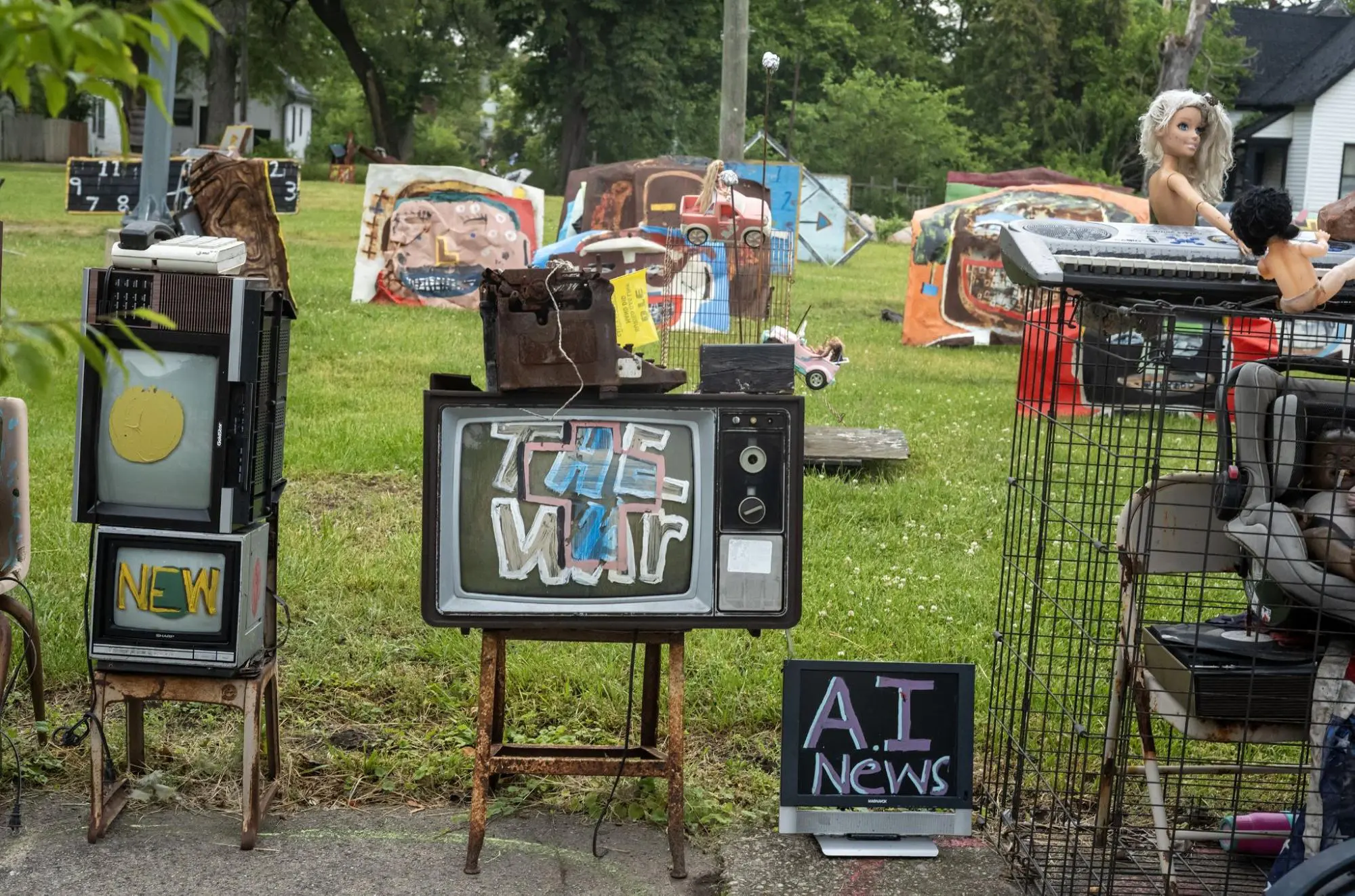
Nearly forty years after he first painted a polka-dotted house on Heidelberg Street, Tyree Guyton’s Heidelberg Project remains one of the most audacious public art environments in the world. Born from neighborhood abandonment and rebuilt after arson, threats of demolition, and doubt from hesitant neighbors, the massive public arts work has become both a philosophy and an economic engine that continues to shape Detroit’s identity on the global stage.
Guyton calls his approach and philosophy Heidelbergology. He describes it as “the practice of reintegrating discarded objects and people into the community from which they came.” Guyton has evolved his ideology of creation into a living practice. Vacant houses became storyboards. Neighborhoods with little investment were turned into open-air museums. And when fires gutted his work, the artist used the setback to dig deeper, finding new ways to use unconventional materials, refusing to accept that anything or anyone could be written off as junk.
“I knew as a kid I wanted to be an artist,” Guyton said. “Yahweh kept me going. This is my life’s work.”
The Heidelberg Project’s reach is undeniable. Jeanine Whitfield, who has worked alongside Guyton for more than three decades, noted that visitors from more than 144 countries have signed the guest book.
“A Williams College study determined the Heidelberg Project was the third most visited cultural destination in Detroit, contributing over $7.2 million to Wayne County,” Whitfield shared. “This was achieved with no government funding. The impact is wild, and it continues to be relevant.”
The Heidelberg Project began in 1986 when Guyton, encouraged by his grandfather Sam Mackey, involved the neighborhood kids to pick up a couple of brooms and brushes and contribute to the transformation of their everyday surroundings. They cleaned their street, then gathered the scattered fragments of thrown-away items and began assembling the scraps into appendages of possibility. Out of boarded-up homes and broken furniture emerged a world of its own. Think of Yayoi Kusama’s obsessive use of polka dots, shapes, and lights spilled over into a constructed universe born from imagination with her pop culture phenomenon—“Infinity Mirror” rooms.
At a time when Detroit’s east side landscape was littered with trash and pockets of neglect, Guyton’s vision dared to imagine that beauty and meaning could grow from waste.
Guyton’s bold contribution did not go without controversy. He endured city demolitions, public criticism, and repeated fires that destroyed parts of the installation. Yet every setback reinforced the project’s resilience in tandem with the growing fascination from the public. One of the pieces from Heidelberg currently on display, Faces in the Hood, still carries the scars from the arson. To Guyton, the evidence of destruction is not tragedy but testimony and proof that art can endure, shift, and be the truth our soul seeks.
The project has provided jobs, youth training, and artist development in a city previously defined by post-industrial ruin. Guyton and his team designed something that became more than a symbol found in some obscure neighborhood—it scaled and became a measurable cultural asset and contributor to the Detroit economy.
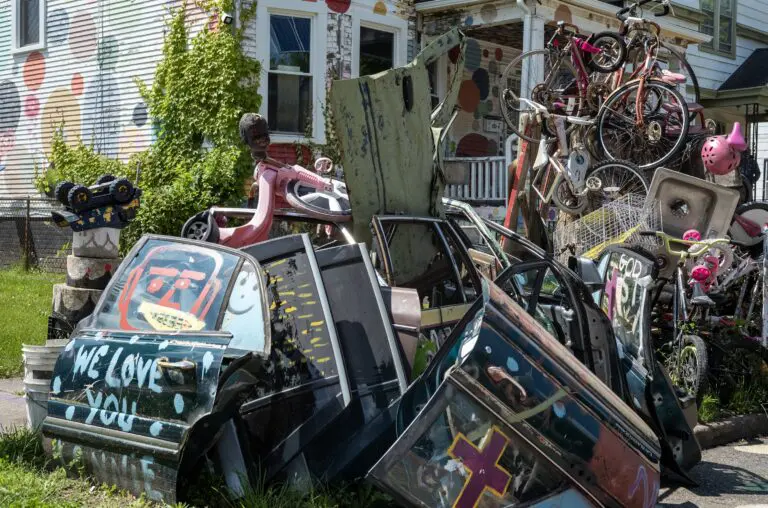
The Heidelberg Project (site view, 2025), Detroit, MI, 1986–ongoing. Photo courtesy of John Michael Kohler Arts Center.
What makes Heidelbergology powerful is the refusal to separate aesthetics from people. Guyton insists the work is as much about healing as art history.
“What we started with, using art as a medicine to heal—recycling not just objects, but the human spirit—is just as important today as it was when I began nearly 40 years ago.”
This fall, his philosophy entered a new chapter. The John Michael Kohler Arts Center in Wisconsin opened Heidelbergology: Is It Art Now? on September 13, 2025, the first major museum exhibition of Guyton’s work. Ten monumental sculptures from the Heidelberg site, including Noah’s Ark—a boat covered with stuffed animals—and Penny Car, a vintage taxi encrusted in pennies, are shown alongside 50 paintings, studies, and archival sketches. The exhibition runs through February 2026, leading directly into the project’s 40th anniversary.
The title comes directly from criticism he once received. Guyton candidly stated,
“People said it was junk. I said, you are right. Let’s put it in a museum and ask the world—Is it art now?”
The question is not rhetorical. Guyton thrives on challenging beliefs with expectation.
“Institutions say art should be this way. I ask myself, can it be this way over here too?” He added, “I’m the salmon swimming upstream.” Guyton’s work isn’t linear for elite approval. It insists that art belongs in inner-city neighborhoods as much as it does in white-walled galleries.
Curators at Kohler see the show as more than a retrospective. “Relocating these works into the gallery challenges us to reconsider our own assumptions about what and where art is,” said Laura Bickford, collections curator.
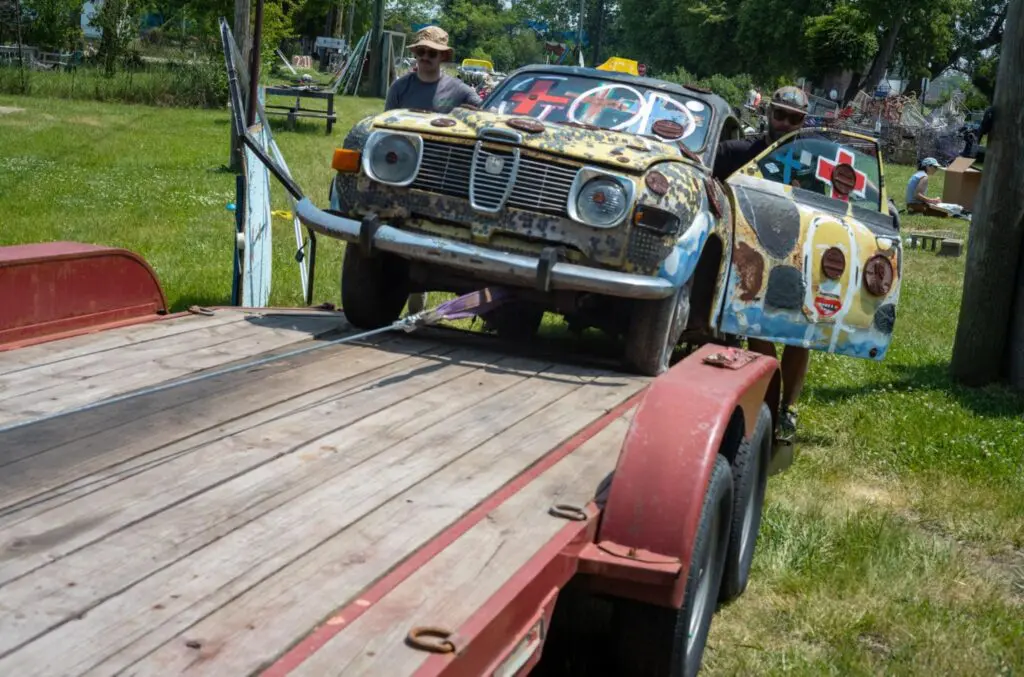
The Heidelberg Project (site view, 2025), Detroit, MI, 1986–ongoing. Photo courtesy of John Michael Kohler Arts Center.
For Guyton, the shift is another way to push boundaries. “If you are an artist in the soul, you can do it anywhere,” he says.
The collaboration with Kohler was years in the making.
“They are the only institution in the world that actually embraces art environments all over the world,” Whitfield explained. “Although we had a couple of false starts, everything happens as it should. Now is the right time, with our 40th anniversary next year. The show aligns perfectly.”
The Heidelberg Project has not always been welcomed. Some residents have been uneasy living alongside an evolving installation. But even detractors cannot ignore its impact. Detroit has benefited from the global attention it generates, and thousands of young people have developed artistic practices and learned the fundamentals of being an artist through Guyton’s program. To dismiss the project is to overlook the evidence of jobs created, tourists drawn, and imaginations sparked.
Guyton is quick to acknowledge his dedicated team. Whitfield helped build the organizational backbone of the project. He credits her business knowledge for providing structure.
“All I want to do is be free to create,” he said. “But you need a team.” That collaboration is itself part of Heidelbergology—bridges built between artists, administrators, and communities to make art sustainable.
As Detroit continues to navigate cycles of reinvention, Guyton is clear about the city’s creative energy.
“You love this place and you hate this place. But what makes it? You got some bad mama jamas here. When everybody else left, people like myself stayed and handled their business. You can’t get rid of this energy—it’s too much,” Guyton adds “It’s going to become greater, especially with the young folks I see today. They are thinkers.”
The Heidelberg Project turns 40 next year. Guyton is “cleaning up,” editing and refining the site, but refuses to predict what comes next.
“I don’t know what the future holds. But I know it holds something,” he says.
What remains undeniable is that Heidelbergology has shifted the frame of what art can be, making Detroit a proving ground for reinvention and a cultural magnet. In the words of Guyton,
“The goal is nothing less than to “challenge the world” with Detroit’s art – to show that from the ashes of decline can rise a creative spirit powerful enough to reinvent a city.”
The upcoming anniversary of Heidelberg is a continuation of a living economy that began with one man’s refusal to see his neighborhood as disposable.
Authors

Infineo Global calls itself a FinTech. The scale of what it is attempting places the company inside a larger conversation
Loneliness is emerging as one of the most significant yet overlooked drivers of substance misuse, and the data shows a

In July 2025, the White House released a digital‑assets roadmap promising to usher in a “Golden Age of Crypto.” On

Winter skin damage doesn’t happen by accident. It’s the collision of seasonal biology and outdated product decisions. The drop in

Tickets go on sale today for Broadway’s revival of Proof, starring Ayo Edebiri and Don Cheadle, directed by Hamilton’s Thomas

New York Edge News | Curators of News and Information Zohran Kwame Mamdani, born in Kampala and raised in Queens,

At this year’s Pepcom-hosted Holiday Spectacular in New York, technology brands shifted the narrative beyond specs and gaming into the

Water is life, but around the world it’s running out. More than 2.2 billion people live without safe drinking water,
For theater lovers who like to travel, Detroit Public Theatre has launched its eleventh season with the American premiere of
The morning of, October 14, 2025, Michael Eugene “D’Angelo” Archer transitioned from this world. The Neo-soul dynasty lost another iconic
Share
CATEGORIES
Need More Help