

Singer Bárbara Bandeira wearing the Portugal Jewels dress
The brand behind Bárbara Bandeira’s one-of-a-kind jewelry dress reopened a royal engraver’s Lisbon storefront in May with hand-painted glass, 18th-century printed cotton and the original stamps on display.
On Rua Áurea in Lisbon, a shop that opened in 1819 now sells 19.2-karat gold filigree. An old advertisement called it the first stamp house in Portugal. Portugal Jewels reopened the address in May as its second Lisbon store. That came four months after the brand built a $105,000 dress entirely from jewelry for singer Bárbara Bandeira.
Portugal Jewels is a family business, and Time Out Lisboa says The New York Times recognized its work in 2025. Now the company is moving old Portuguese jewelry out of the display case. First it went onto a pop star. Next it moved into a storefront with a past. The company says the new store sits on one of Lisbon’s most commercialized stretches, where old shops often become chain retail or short-term rentals.
The advertisement is for E. E. de Sousa & Silva, engravers. It is specific about the trade: stamps of every kind, plus steel and gold rings engraved with coats of arms, crowns and monograms. It lists the address as 157 Rua do Ouro, another name for Rua Áurea. The Portuguese crown set that street aside for goldsmiths and jewelers in 1760. By the late 19th century, the shop held the warrant of the Portuguese Royal House, according to Portugal Jewels.
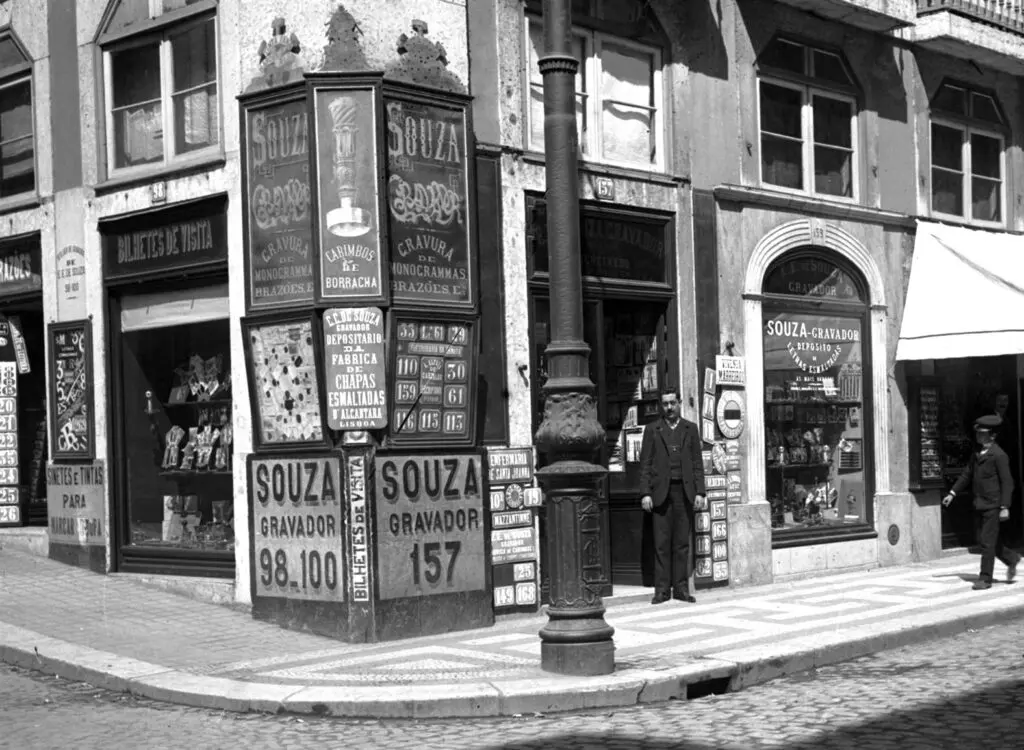
After 206 years, the previous owner had no family to take over. As a result, the owner chose a successor. Time Out Lisboa reports the shop closed in 2025. Portugal Jewels reopened it in May, and Portuguese outlet NIT reported the date as May 21.
Still, from the sidewalk the shop reads as an engraver’s. Painted lettering above the windows lists business cards, rubber stamps and office supplies beside “Casa fundada em 1819.” The new part is in the glass. Designer and lettering artist João Neves hand-painted panels in the brand’s blue, using reverse painting and gold leaf. They sit beside the shop’s original panels.
Inside, creative director Ricardo Preto wanted visitors to feel they had entered a Portuguese home, not a store. For that reason, the walls are lined in Chita de Alcobaça, a block-printed cotton produced since the 18th century. Armazém dos Linhos, a Porto house founded in 1905, supplied it. Ratinho ceramics, woven wicker baskets and restored antique furniture hold the jewelry. In addition, stamps from the shop’s first tenant are on display.
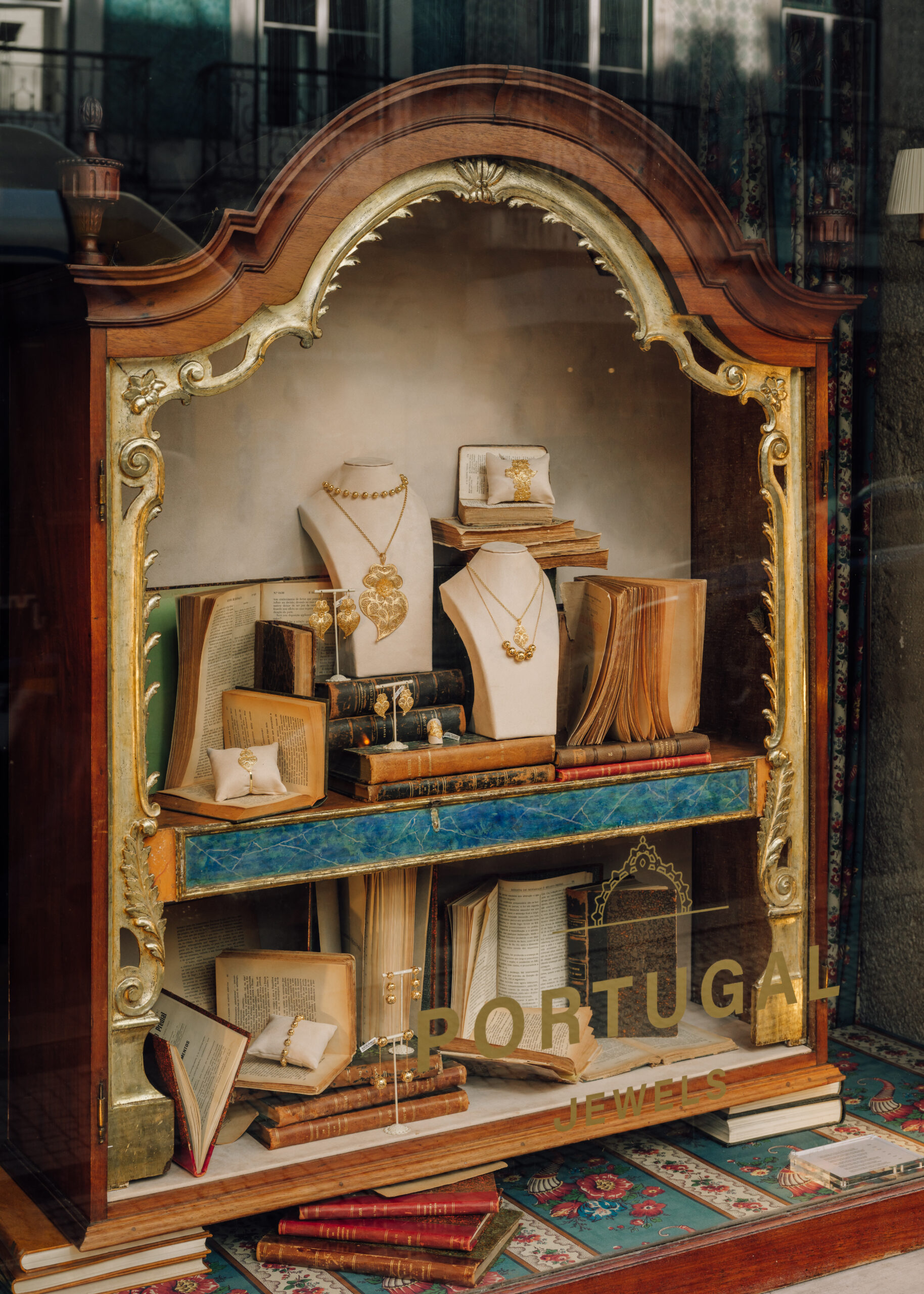
Photo: Francisco Nogueira / Portugal Jewels. “Courtesy of Portugal Jewels.”
This is the brand’s second restoration in two years. In 2025, Portugal Jewels opened its first Lisbon store at Largo do Chiado 4. The space was formerly Barbearia Campos, a barbershop founded in 1886. The brand says Fernando Pessoa, Eça de Queiroz and Almada Negreiros visited it. Time Out Lisboa reports it closed in December 2023.
The Lisbon studio LADO kept the Carrara marble counters, mirrors and chairs. It then added cabinetry in Klein blue. As a result, the project became a finalist in retail design at the 2025 SBID International Design Awards. The German Design Award also lists it as a winner in its Excellent Architecture category for retail architecture.
The dress is the modern end of the same story. By contrast, where the old shop cut coats of arms and monograms into rings, this piece was made for one wearer. André Rodarts built it by hand from Viana Hearts, Queen Earrings, Galician Earrings, filigree and spiral motifs. It weighs 7 kilograms. Bandeira and Raquel Guerreiro developed the concept, and the brand says the dress was made for the demands of movement on camera. The company values it at about €90,000, or $105,000.
Rúben do Valle directed the video, which was shot on 35mm in Viana do Castelo. Guerreiro is credited as its stylist. According to a company statement reported by Diário de Notícias, the video places the dress among marchas, mordomas and cabeçudos from the Festas da Senhora d’Agonia in Viana do Castelo. Joana Bastos Gomes, identified by the brand as its founder, said jewelry can exist at scale “as language rather than detail.”
The family’s jewelry business goes back to 1955, when a grandfather opened a workshop in Gondomar, according to the brand’s Lisbon Tourism profile. Siblings Alexandre and Joana Bastos Gomes launched Portugal Jewels in 2017 as the third generation. The brand says independent goldsmiths in the north of Portugal make every piece. It sells through more than 60 points of sale.
NIT reported 2025 turnover of about €4 million, up 50 to 60 percent from the year before.
Related coverage on New York Edge News
Street Signs, Sci-Fi and Teen Curators Take Over the Bronx Museum